

1. What is a wine broker?
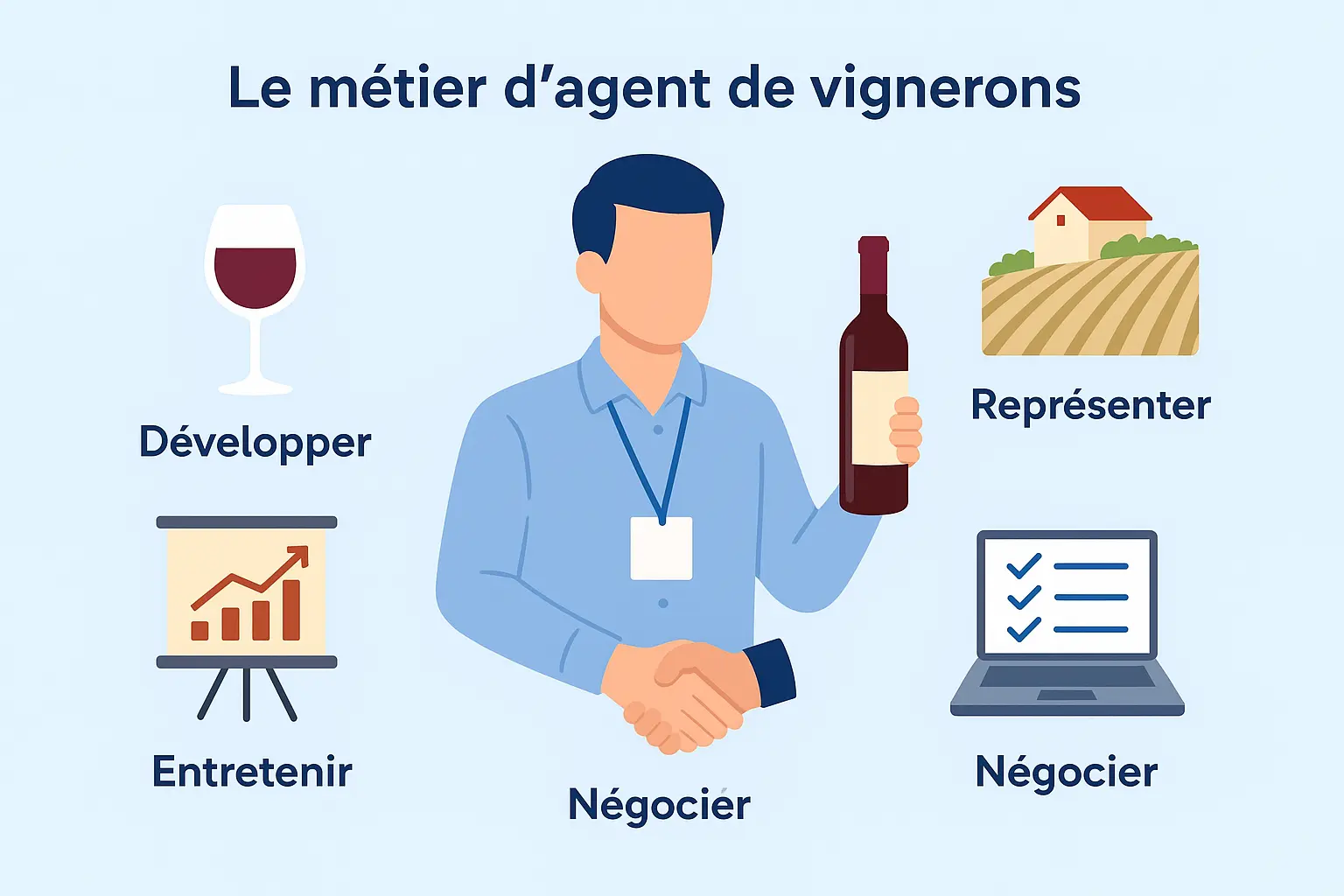
A wine agent (or wine sales representative) is an independent agent (registered with the RSAC) who does not sell on their own behalf: they represent multiple wineries, wine merchants, or wine houses to promote, negotiate, and develop sales to professional buyers (restaurants, hotels, and cafés; wine shops; supermarkets; etc.).
He acts as an intermediary: he identifies potential customers, presents product lines, negotiates terms, places orders… and earns a commission on sales made.
📘 Legal basis: Articles L.134-1 et seq. of the Commercial Code.
The winegrowers' agent neither buys nor stocks wine, but serves as the producers' public face in the field. His role combines sales, advocacy, and network coordination.
🔗 In 2022, Le Figaro published a superb article on the 👉 role of a wine agent
2. Context 2025: A Changing Wine Market
The wine industry is going through a mixed period:
- A decline in household consumption, but a shift toward higher-end products (less, but better).
- Globalization, with increased pressure on competitiveness.
- Rising logistics costs: transportation, glass, breakage, shipping costs...
- A sharp rise in e-commerce is hurting brick-and-mortar stores.
- New expectations (organic and natural wines, HSE).
👉 Nevertheless, the wine agent serves as a strategic linchpin: they bring on-the-ground experience, a local presence, and market expertise to the wineries they represent.
3. The main responsibilities of a vineyard manager
A typical week?
Road trips, tastings, sales, restocking—and a healthy dose of passion!
Here are the key tasks:
- Prospect: identify new wine retailers, restaurant owners, or distributors.
- Present the wineries and organize professional tastings.
- Negotiate: rates, discounts, delivery times, free shipping, and regional exclusives.
- Track orders and ensure that payments are received.
- Provide winemakers with feedback from the field (trends, customer feedback).
- Attend trade shows (Wine Paris, Vinexpo, regional trade shows, etc.).
- Sourcing new products (trade shows, peer recommendations)
The Goal: to balance business growth between acquiring new customers and retaining existing ones.
👉 Check out our comprehensive guide on how to become an independent sales agent
4. How much does a wine merchant earn?
The agent is paid on commission: he earns nothing unless he makes a sale, but he retains complete independence.
Here are the ranges of average commissions observed:
💡 Good to know: The commission is paid once the winemaker has received payment for the order (a common clause in agency agreements). 👉 Here is the complete guide to commercial agency agreements
The average income of an experienced agent depends on:
- Number of active mandates
- Mixed customer base (restaurants, bars, and wine shops / wine retailers / supermarkets)
- Seasonal factors (end of the year, trade shows, etc.).
🔗 See also: Salary & commissions for a sales representative
5. His portfolio of assignments
Most wine agents handle between 10 and 30 accounts.
Their portfolio is often a balanced mix of:
- Wines and Champagnes (the core of our selection)
- Niche spirits (gin, whiskey, rum, cognac, armagnac)
- Craft beers (to increase margins and expand the hospitality customer base)
- Gourmet food products (to diversify the product range)
Key factors for a successful portfolio:
✅ Diversify the appellations without creating competition among them
✅ Cover the major wine regions (e.g., Loire, Burgundy, Southwest, Bordeaux)
✅ Have 1–2 “best-sellers” (volume) and 1–2 “hidden gems” (image)
Too many cards muddle the message; too few limit the possibilities.
🔗 Two months ago, Vitisphère published a study on how to choose and work with a winegrowers' agent.
6. How do you get started as a wine agent?
Two main routes:
Purchase an existing portfolio
Benefits:
- Faster revenue because sales are already underway
- Existing customer relationships, which make it easier to sell new products.
- Simplified returns to the wineries
Disadvantages:
- Sometimes high cost (often equivalent to two years' worth of commissions)
- Requires thorough due diligence (quality of the pipeline, customer retention, terms of the agreements).
Create your portfolio
Benefits:
- Freedom of choice, personal stance
- Advantages: the ability to set your own pace and use your own methods
Disadvantages: - Time until the first commissions (6 to 12 months)
- Need to invest in travel and trade shows
Disadvantages:
- Difficult starting - Slow acceleration
- First orders often take months to arrive.
- We have to start from scratch
💡 Karavane Tip:
Buy a few cards to generate some initial income and, most importantly, to get your foot in the door with your customers.
7. Tools and software used by agents
Wine agents are increasingly using digital tools to organize their sales rounds and take orders
Here are the must-have tools:
- B2B Order Processing: VinoVentePro, VINIVRP, Winetailors, or the winery’s platform.
- CRM (customer relationship management): contact tracking, reminders, order history— Moovago is highly popular among agents.
- Schedule / Tours: to plan your trips and group visits by area.
- Reporting: tracking sales by payment method and customer segment.
🔗 See also: Sales Representative Toolkit
8. Logistics and Free Shipping: A Key Issue
The wine industry is logistically challenging: the products are heavy, fragile, and susceptible to weather conditions.
The agent must navigate the shipping policies of the wineries and the various carriers involved:
- Franco by the case (24 or 36 bottles)
- Bulk wine (often 500–600 bottles)
- Consolidated shipping to optimize costs
- Returns Management / Damaged Goods / Best-Before Date
Storage at the agent's location?
It's possible (and some people do it), but it involves:
- cash tied up,
- risk of breakage,
- the need for insurance and tax compliance.
- higher pay, since warehousing often involves delivery.
💬 In short: an agent should not take on the role of a logistics specialist unless this is specified in the contract and the agent is compensated for this service.
9. Where can I find new maps?
The wine merchant finds his clients:
- at trade shows (Wine Paris, Millésime Bio, regional trade shows),
- through specialized platforms such as Karavane,
- based on recommendations (agents, winemakers, sommeliers, buyers),
- and sometimes through direct outreach (email, phone, LinkedIn).
10. Seasonality of the profession
The daily routine of a vineyard manager follows the cycles of the wine-making process:
- January through March: new vintages, trade shows.
- April through June: stocking of rosé wines, restocking for the foodservice sector.
- September through December: peak season (gifts, holiday season).
- Grape harvest (September): limited availability from winemakers → plan ahead.
🎯 Tip: Schedule follow-ups with customers 7 days and 30 days after each trade show or tasting to maximize orders.
🔗 Read the Génération Vignerons article on 👉 the profession of wine agent
11. Winegrowers' agent vs. distributor
👉 In some regions, both models coexist: the agent handles customer service, while the distributor manages volume and logistics.
12. FAQ: Everything You Need to Know About the Role of a Wine Agent
What is a wine broker?
An independent agent who promotes the sale of wines and spirits on behalf of producers and is paid on a commission basis.
How much does he make?
Commission ranges from 10% to 20%, depending on the product. On average, €35,000 to €80,000 per year, depending on seniority and portfolio size. Sometimes much more!
How many accounts does he manage?
Typically 8 to 20 maps, covering 2 to 3 complementary regions.
Who are its customers?
Foodservice (restaurants, bars, hotels), wine shops, specialty food stores, wholesalers, and sometimes supermarkets.
What tools does he use?
Order management tools (VINIVRP, VinoVentePro), CRM, calendar, dashboards.
Can it store wine?
Yes, but that requires insurance and a clear tax framework.
Should you meet with your winemakers often?
Yes: at least once a year, plus regular updates (new vintages, ILV, events).
What about seasonality?
Business peaks between September and December (the holiday season), with a pickup in the spring.
How is this different from a vending machine?
The agent doesn't resell—he promotes and develops the business. The distributor buys, stocks, and delivers.
How do I find new maps?
At Karavane, at trade shows, or through professional networks.

.webp)