


1. Definition of a commercial subagent
A sub-agent is a natural or legal person who acts on behalf of a commercial agent, rather than directly on behalf of the principal (the company). They operate under a chain of authority, within the framework of a delegation of authority. Therefore, they do not sign a contract with the company, but with the principal agent.
This practice is common in certain sales networks, where a lead agent delegates part of their sales responsibilities to a third party, often to cover a larger territory.
👉 Check out our comprehensive guide to the role of an independent sales representative.
2. Is that legal?
Yes, the practice of sub-agency is legally recognized under French law, provided it meets certain conditions. It is governed by Article L.134-1 et seq. of the Commercial Code.
💡 Source: Aumans Avocats – Subagents
The principal agent must obtain authorization from the principal to subcontract part of the work. This must be clearly stated in the original contract.
3. What type of contract should a subagent have?
The contractual relationship between the principal and the subagent is established through a commercial subagency agreement.
This contract must specify:
- The scope of the tasks assigned
- The relevant territory or portfolio
- The commission rate
- The duration
- Terms of termination
It is strongly recommended that you put this in writing to avoid any disputes.
👉 Check out our comprehensive guide to independent sales agent contracts
4. How does it work in practice?
The principal agent receives a mandate from the company. The principal agent then decides to delegate part of that mandate to a subagent.
- The sub-agent solicits business and makes sales, but does not deal directly with the principal
- It is not included in the basic contract
- He is not liable to the company, but to the agent
🧠 Note: The principal has no legal relationship with the subagent.
5. Why hire a subagent?
Here are some common reasons:
- Expand the network across a region
- Strengthen an existing team without increasing payroll costs
- Test a new area or a new target
This is a strategy often used by many experienced agents to expand their network more quickly.
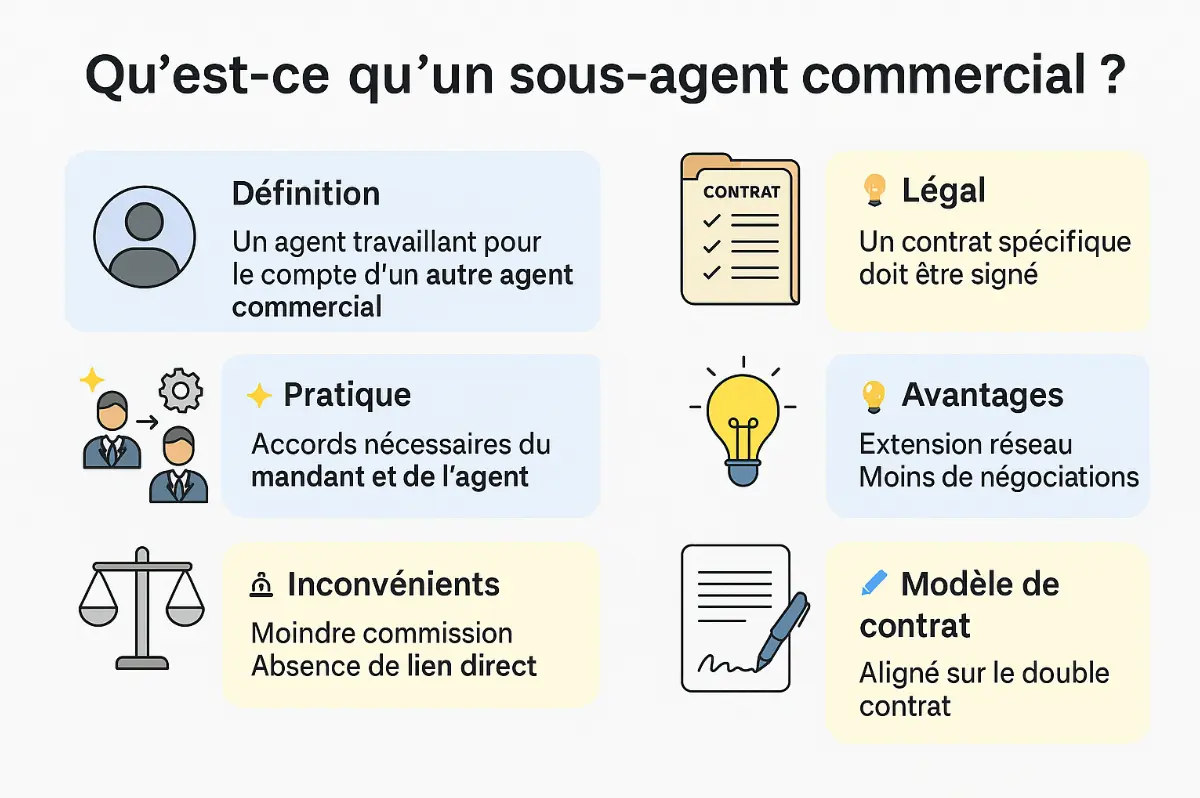
6. Pros and Cons
Benefits
- Geographical agility 🌍
- Flexibility in collaboration
- No connection to the client
- Access to highly desirable projects
Disadvantages
- Less corporate control over the relationship
- Lower commission (due to an additional intermediary)
- Risk of reclassification if roles are poorly defined
- Administrative complexity for the lead agent
7. Subagent = lower pay?
Generally speaking, yes. The sub-agent receives a sub-commission, which is set by the principal agent. The sub-agent does not negotiate directly with the brand.
But:
- He doesn't have to handle customer relations
- It does not cover marketing or reporting costs
- He can focus solely on sales
💬 It’s a trade-off between operational simplicity and lower pay.
👉 Read our detailed report on sales representative salaries
8. Which court?
In the event of a dispute between the subagent and the principal agent:
- The competent court is the one specified in the subagent agreement
- The principal cannot be held liable, except in exceptional cases
📌 In the event of a serious dispute, either party may bring the matter before the commercial court.
9. Is there a sample contract?
Yes, several contract templates are available:
However, it is recommended that you have your contract reviewed by a legal professional to avoid any procedural errors or unfair terms.
👉 Check out our comprehensive guide to independent sales agent contracts
FAQ: Sales Agent
What is a commercial subagent?
→A sales representative acting under the supervision of an agent, with no direct connection to the principal company.
Can someone become a subagent without the principal’s consent?
→No, the principal must be contractually authorized to delegate.
What is the legal status of a subagent?
→He is a freelancer working as a subcontractor for another freelancer.
Does a subagent need to be registered with the RSAC?
→A sub-agent is a full-fledged commercial agent and is therefore required to register with the Special Registry of Independent Commercial Agents (RSAC)
Is there a risk of reclassification?
→ Yes, exercise caution if there is a reporting relationship or a blurring of roles.